Send the data that changes compressor selection
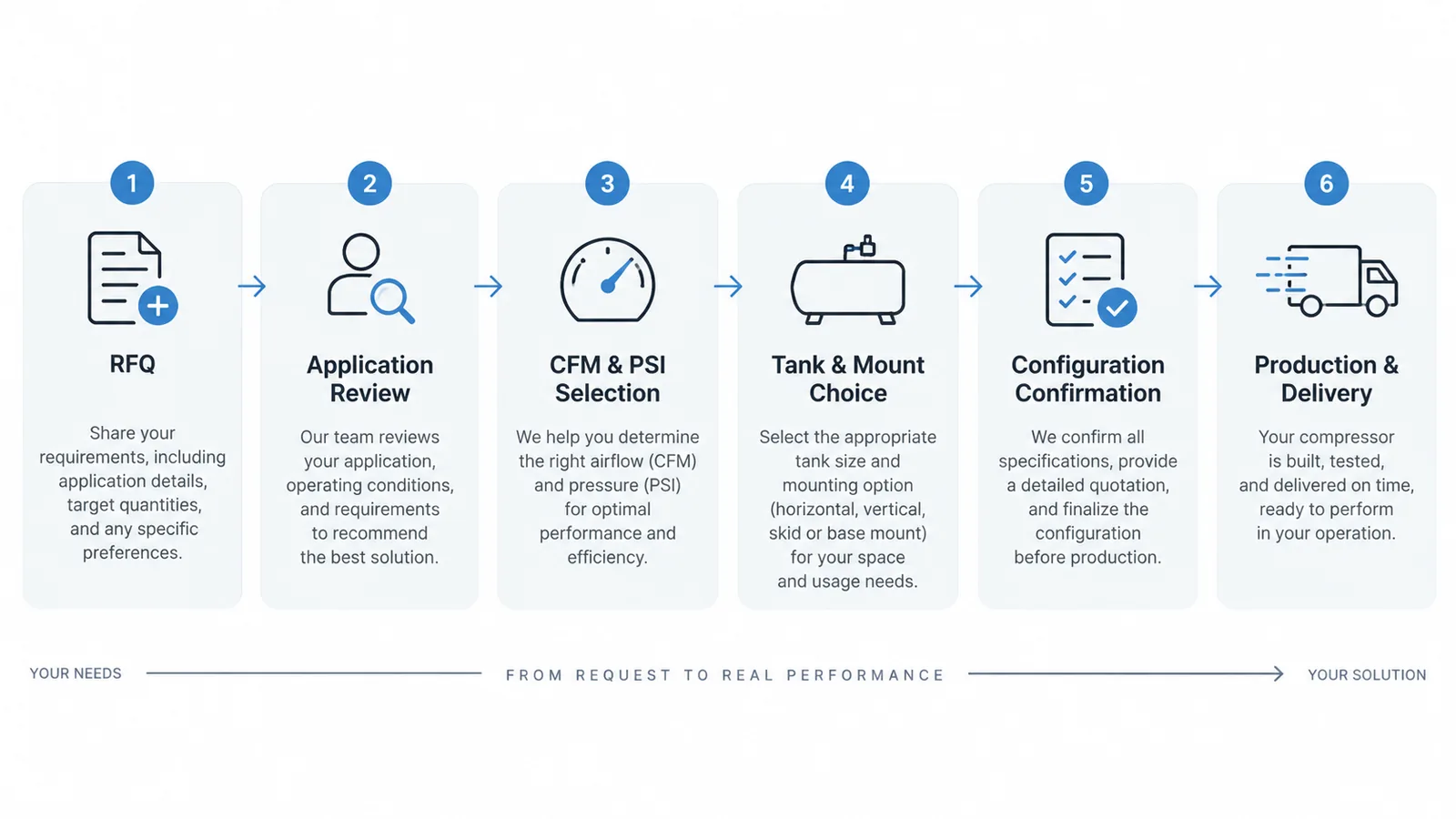
For the most useful quotation, send required pressure, airflow, operating hours, voltage/frequency, quantity, destination, ambient conditions and any air-quality requirement. If you are replacing an existing compressor, include its model and the reason for replacement. For machine integration, add dimensions, connection position and any drawing that defines the available envelope.

Order planning
注文計画と最小発注数量(MOQ):標準コンプレッサーおよびサービス部品の注文は、実用的な生産数量で供給され、正確なMOQはモデルによって異なります。高額または大型の機器は、個数ではなく注文総額で検討される場合があります。新規のお客様は、選択した品目がサンプルに適している場合、サンプル価格で評価用に1~5個をリクエストできます。複数のモデルを組み合わせて、1,500米ドルの注文金額にすることができます。特殊な材料、仕上げ、またはプロセス固有の構成については、該当する生産MOQが適用されます。輸出処理とエンジニアリングサポートを経済的に維持するため、1~2個の小売注文は処理されません。モデル、必要な数量、および配送先をお知らせいただければ、見積もり用に実用的な注文構成をご提案いたします。
Email: [email protected]
Address: Sandan-ro | Danwon-gu | Ansan-si | Gyeonggi-do | Korea
What happens after your enquiry
We review the operating point, identify missing technical data and compare the request with the current compressor families. Where several configurations are plausible, the response should explain what changes the selection rather than simply naming the largest model. Special process conditions, high pressure and clean-air requirements receive additional integration checks.

Operating conditions that should be stated in the specification
A useful compressor RFQ and project review specification distinguishes the normal operating point from the most demanding realistic condition. Record ambient temperature, intake-air cleanliness, humidity, elevation where it is relevant, working hours, starts or load changes, and the minimum acceptable pressure at the user. For an existing system, note whether demand is stable or seasonal and whether pressure problems occur during one specific shift or process step. These observations often explain why two installations using the same nominal compressor size can perform differently.
Distribution details belong in the same specification. Pipe diameter, hose length, filters, dryers, valves and quick couplers all create resistance. A compressor should not be upsized automatically to compensate for a restrictive distribution network. Measure pressure close to the compressor and again at the user during peak demand; a large difference points to system loss rather than insufficient compression capacity. This distinction prevents unnecessary equipment expansion and makes the corrective action easier to verify.
Serviceability, commissioning and long-term operating discipline
Service access should be designed before the machine arrives. Keep filters, drains, control panels, coolers and connection points reachable, and avoid placing the compressor where hot exhaust air is pulled back into the intake. Commissioning should create a baseline that includes loaded pressure, running current, temperature, recovery or loading behavior, drain function and abnormal-noise observations. That baseline is more useful than a generic maintenance interval because it gives technicians a known healthy condition for comparison.
During service, investigate trends rather than isolated symptoms. Rising temperature, longer recovery, frequent cycling or a gradual loss of point-of-use pressure may indicate filter restriction, leakage, cooling deterioration or changed plant demand. Record what changed and confirm the effect after maintenance. For high-pressure equipment, isolation and pressure-rated downstream components require extra attention; for clean-process air, downstream treatment and condensate control remain important even when the compression stage is oil-free.