
Alimentation en air comprimé conçue autour des données d'application
Korea Ever-Power Air Compressor Co., Ltd. propose un service d'assistance au choix de compresseurs depuis son site d'Ansan-si, dans la province de Gyeonggi-do, en Corée. La gamme de produits actuellement présentée sur ce site est axée sur les compresseurs à réservoir sans huile, les compresseurs à vis sans huile à injection d'eau et les compresseurs à vis moyenne/haute pression. Les compresseurs à moteur essence seront ajoutés ultérieurement, lorsque les informations techniques spécifiques à chaque modèle seront disponibles.
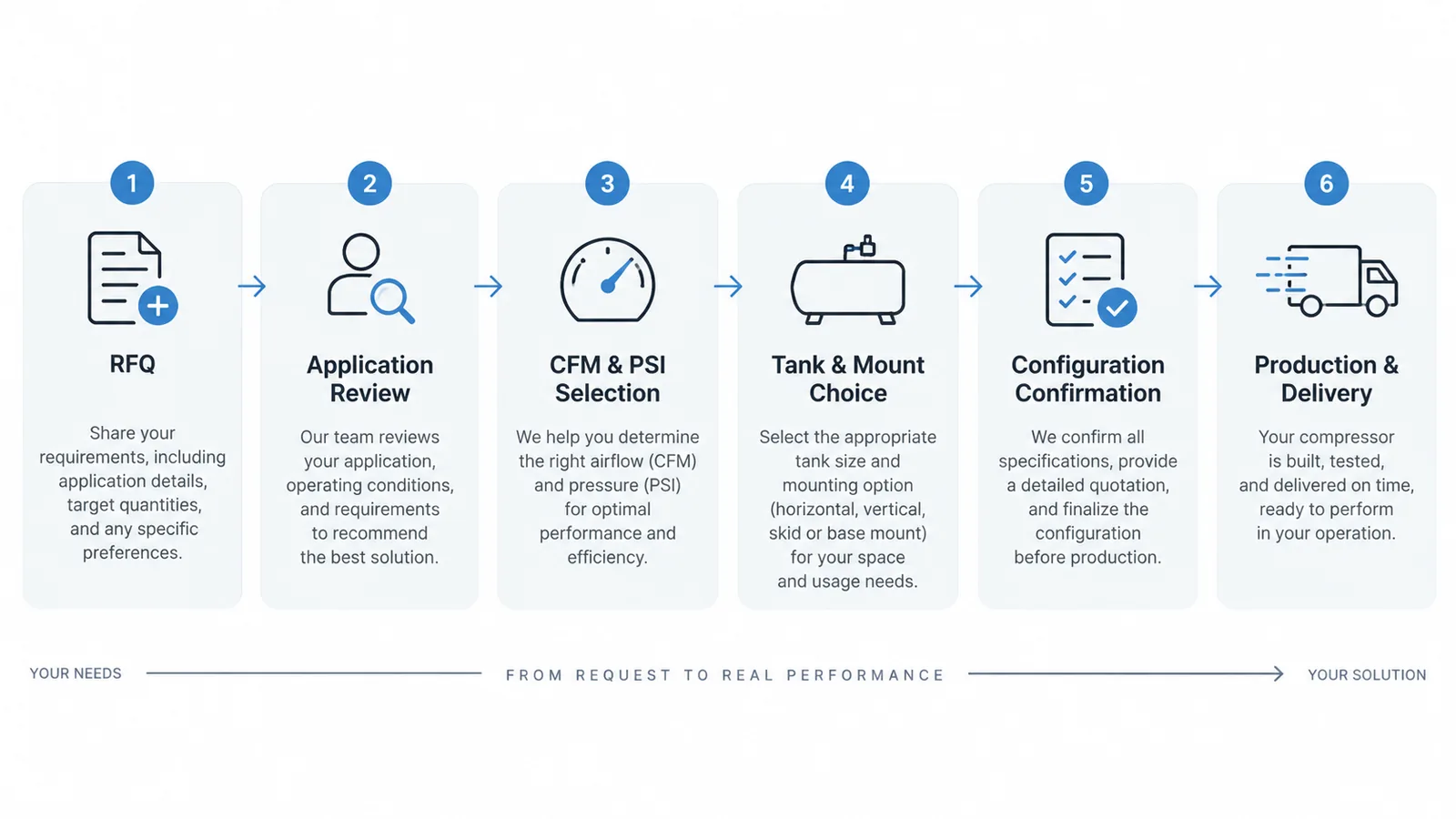
Notre rôle est d'aider les acheteurs à passer d'une demande générale à une configuration permettant d'établir un devis et de procéder à une vérification. Cela implique de préciser la pression, le débit, le cycle de service, l'alimentation électrique, les exigences environnementales et de qualité de l'air, les besoins de raccordement et les dimensions d'installation avant de considérer un modèle comme adapté.
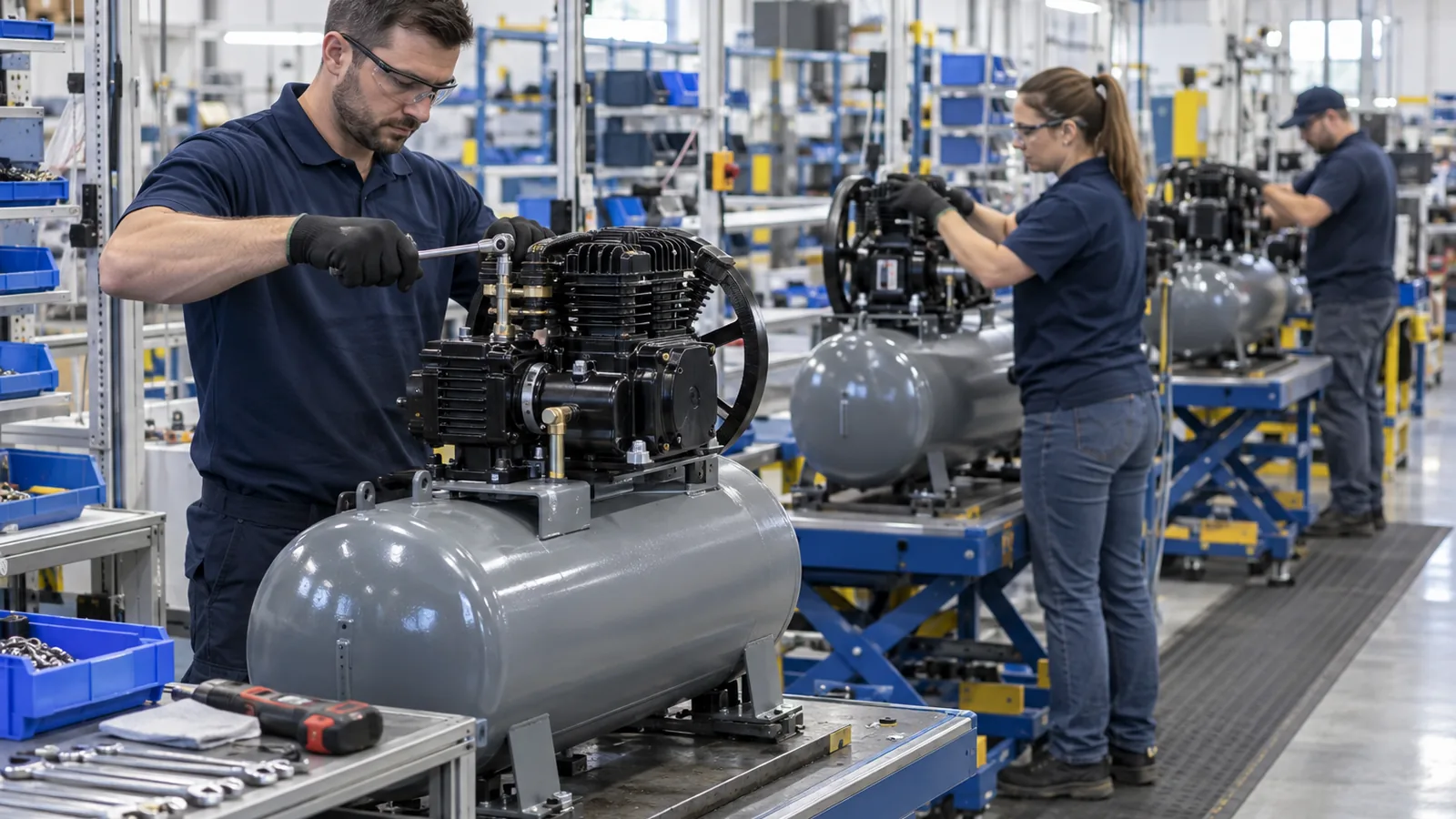
Flux de travail de sélection technique
La sélection commence par l'analyse des équipements consommateurs. Nous identifions la pression de service et le besoin en air comprimé, distinguons la consommation continue des pics et vérifions les pertes de charge et les exigences du réservoir. Pour les systèmes à vis, le refroidissement et la ventilation sont pris en compte en plus du débit. Pour les projets moyenne/haute pression, la classe de pression aval complète est analysée.
Lorsque les données d'un projet sont incomplètes, les éléments manquants sont transformés en questions de demande de prix plutôt que d'être remplacés par des hypothèses. Ceci est particulièrement important pour l'approvisionnement en électricité destiné à l'exportation, la qualité de l'air de process, les interfaces spécifiques et les conditions ambiantes inhabituelles.
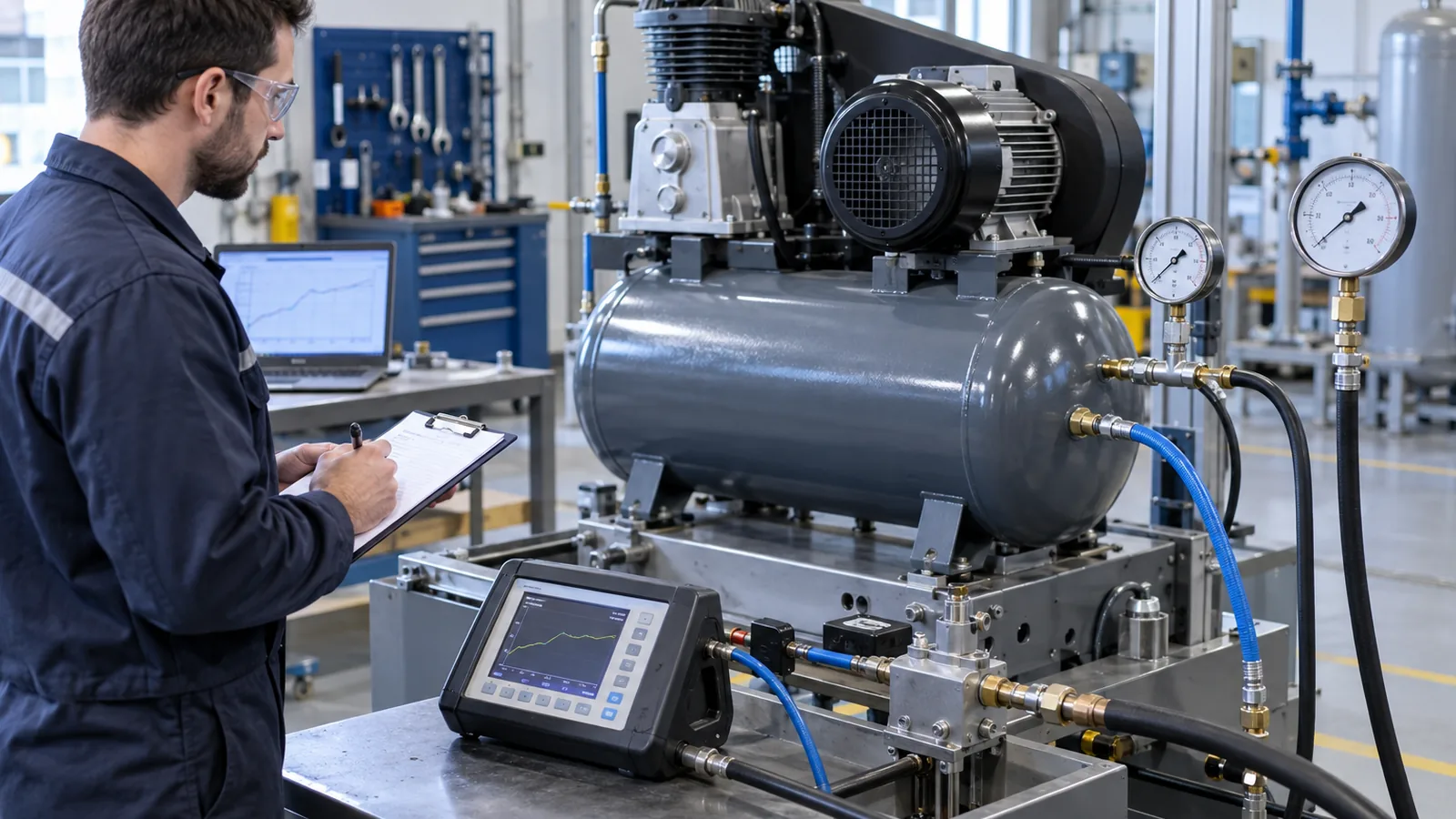
Approche qualité et inspection
La planification des inspections porte sur l'identification de la configuration, la réponse à la pression et aux commandes, l'état visible, les connexions, les éléments électriques et les paramètres pertinents pour la commande spécifique. Les données de mise en service servent de référence pour la maintenance. Pour les projets critiques en termes de dimensions et d'interfaces, il est recommandé d'utiliser des plans et des contrôles de réception explicites plutôt que de se fier uniquement aux photographies du produit.
Assistance avant et après le devis
Avant l'établissement du devis, nous facilitons l'organisation des données techniques. Lors de la vérification de la commande, nous veillons à ce que les détails de configuration soient liés au modèle sélectionné. Après la livraison, notre assistance à la maintenance et au dépannage porte sur les conditions d'installation, les filtres, le drainage, le refroidissement et les pertes de charge du système. L'objectif est de fournir un cahier des charges du compresseur compréhensible par le service des achats et exploitable par l'équipe technique. Notre assistance comprend également l'aide aux acheteurs pour identifier les données manquantes du projet avant que cela ne pose problème lors de la commande. Les contraintes liées à l'alimentation électrique, à la pression, au débit, au refroidissement et à l'installation sont enregistrées en amont afin de permettre une comparaison équitable des devis. Pour les projets de remplacement, les données de la machine actuelle et le motif du remplacement sont essentiels car ils permettent d'identifier si le problème est lié à la capacité, à la fiabilité, à la qualité de l'air, à l'agencement ou à une évolution de la demande de production.
Conditions de fonctionnement qui doivent être mentionnées dans les spécifications
Un cahier des charges utile pour la fourniture et l'assistance technique d'un compresseur d'air permet de distinguer le point de fonctionnement normal des conditions réalistes les plus exigeantes. Il convient de consigner la température ambiante, la propreté de l'air d'admission, l'humidité, l'altitude (le cas échéant), les heures de fonctionnement, les démarrages ou les variations de charge, ainsi que la pression minimale acceptable chez l'utilisateur. Pour un système existant, il est important de noter si la demande est stable ou saisonnière et si des problèmes de pression surviennent lors d'un poste de travail ou d'une étape de processus spécifique. Ces observations permettent souvent d'expliquer les différences de performances entre deux installations utilisant un compresseur de même taille nominale.
Les détails de la distribution doivent figurer dans le même cahier des charges. Le diamètre des tuyaux, la longueur des flexibles, les filtres, les déshydrateurs, les vannes et les raccords rapides sont autant de facteurs qui génèrent des résistances. Il est déconseillé de surdimensionner automatiquement un compresseur pour compenser un réseau de distribution restrictif. Mesurez la pression à proximité du compresseur, puis à nouveau chez l'utilisateur lors des pics de consommation ; une différence importante indique une perte de charge du système plutôt qu'une capacité de compression insuffisante. Cette distinction permet d'éviter un surdimensionnement inutile de l'équipement et facilite la vérification des mesures correctives.
Discipline de maintenance, de mise en service et d'exploitation à long terme
L'accès pour la maintenance doit être prévu avant la livraison de la machine. Veillez à ce que les filtres, les purgeurs, les panneaux de commande, les refroidisseurs et les points de raccordement soient facilement accessibles et évitez de placer le compresseur à un endroit où l'air chaud des gaz d'échappement est aspiré. La mise en service doit établir des valeurs de référence incluant la pression en charge, le courant de fonctionnement, la température, le comportement en reprise ou en charge, le fonctionnement du purgeur et les observations de bruits anormaux. Ces valeurs de référence sont plus utiles qu'un intervalle de maintenance standard car elles offrent aux techniciens un état de fonctionnement normal connu, servant de point de comparaison.
Lors de la maintenance, il est important d'analyser les tendances plutôt que les symptômes isolés. Une hausse de température, un temps de récupération plus long, des cycles fréquents ou une perte progressive de pression au point d'utilisation peuvent indiquer un colmatage du filtre, une fuite, une détérioration du système de refroidissement ou une modification des besoins de l'installation. Il convient de consigner les changements observés et d'en vérifier l'effet après la maintenance. Pour les équipements haute pression, l'isolation et les composants aval résistants à la pression nécessitent une attention particulière ; pour l'air de process propre, le traitement aval et la maîtrise des condensats restent essentiels, même lorsque l'étage de compression est exempt d'huile.